
Astrology Was Never Separate from the Sky
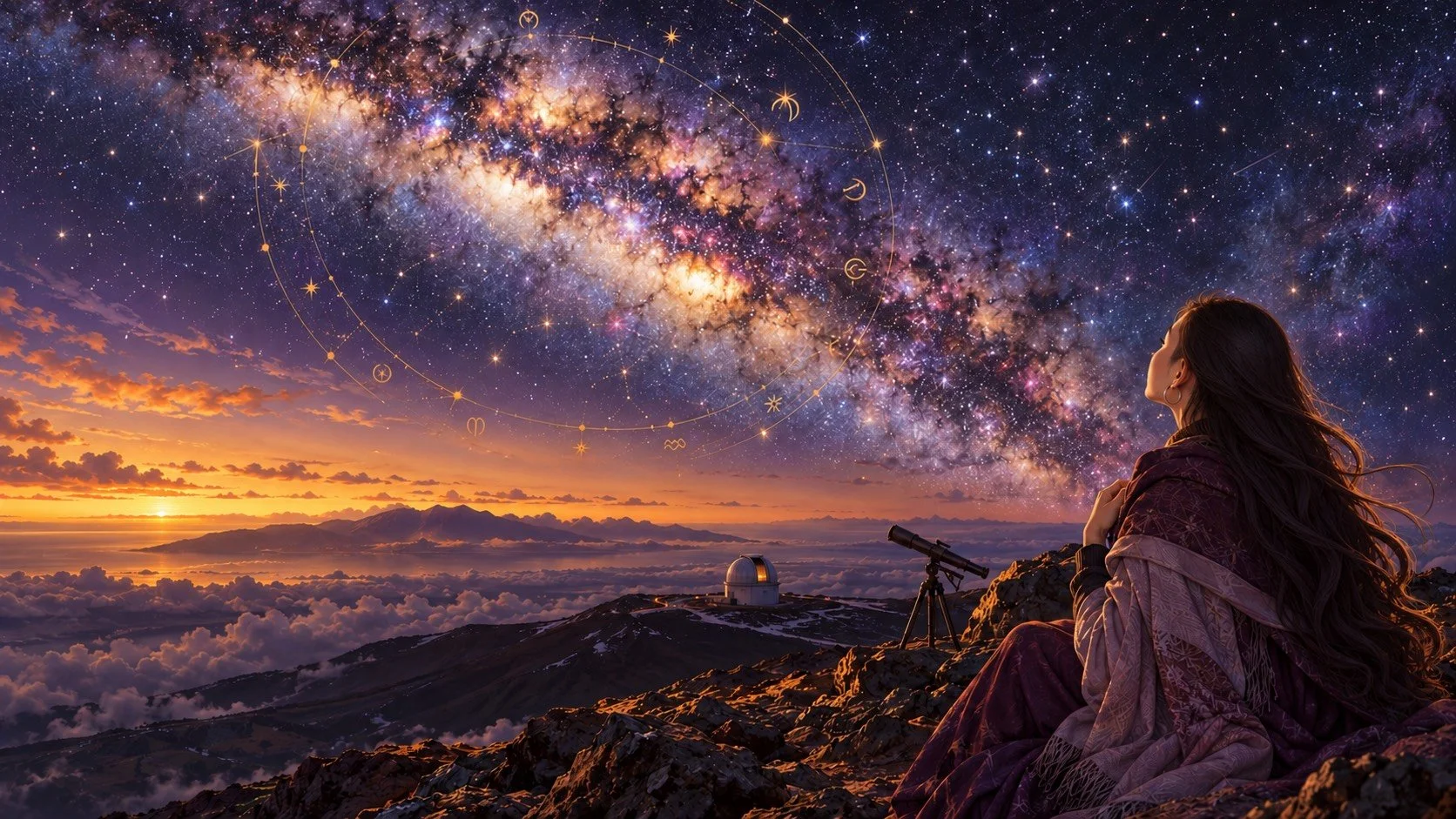
How the split between astrology and astronomy changed our relationship with the cosmos—and what we might rediscover by looking up again.
Some of you may be old enough to remember an interesting bit of information that floated around in the late 1990s:
The astrological dates were wrong.
Or at least, that was how the story was often presented.
Like so many sensational stories, it briefly captured people’s attention before disappearing again. But if you’re anything like me—someone who has always felt an inexplicable fascination with the cosmos—the question may have lingered somewhere in the back of your mind.
It certainly lingered in mine.
Years later, after becoming an avid student of Eastern philosophy and eventually Yoga, I encountered Vedic Astrology, or Jyotisha. I immediately recognized the familiar signs of the zodiac—Aries, Taurus, Gemini, Cancer and so forth.
But something was different.
The dates didn’t match.
How could that be?
Were we not looking at the same sky, from the same Earth, within the same solar system?
That seemingly simple question opened a door that would profoundly change the way I understood astrology.
Two Zodiacs, One Sky
The difference I had stumbled upon was the distinction between the tropical and sidereal zodiacs.
Most modern Western astrology uses the tropical zodiac. Vedic Astrology generally uses a sidereal zodiac.
Both divide the ecliptic—the apparent path of the Sun through our sky—into twelve equal 30-degree signs. But they anchor those signs differently.
The tropical zodiac anchors itself to the seasonal cycle, beginning 0° Aries at the March equinox.
A sidereal zodiac instead references the zodiac against the stars, using a calculated offset known as an ayanamsha to account for a phenomenon called the precession of the equinoxes.
And this is where astronomy enters our story.
The Earth Is Moving in More Ways Than We Notice
Most of us are familiar with several of Earth’s great movements.
Earth rotates on its axis, creating our experience of day and night.
It revolves around the Sun, creating our year.
Its axis is tilted relative to the plane of its orbit, contributing to our seasons.
But there is another, much slower movement that most of us rarely think about.
Earth’s rotational axis itself slowly changes direction.
Imagine a spinning top. As it spins, its axis gradually traces a circle. Earth does something similar, although on an almost unimaginably larger timescale.
This movement is called axial precession.
One complete cycle takes roughly 26,000 years.
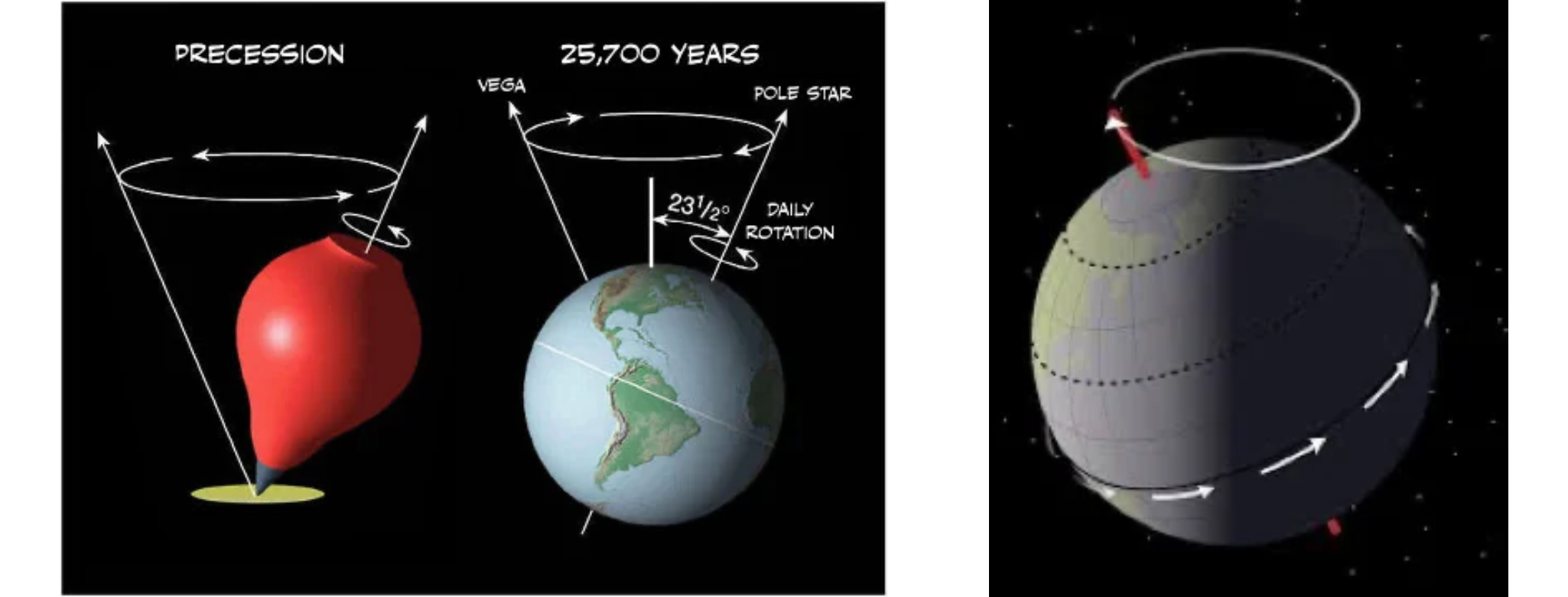
The gravitational influence of the Moon—and, to a lesser degree, the Sun—acting upon Earth’s equatorial bulge contributes to this slow precessional movement. As a consequence, our orientation relative to the stellar background gradually changes over immense stretches of time.
We don’t notice this from one birthday to another.
But over centuries and millennia, it matters.
The sky is not a static backdrop.
And neither are we.
The Zodiac and the Constellations Are Not the Same Thing
This is also where I would clarify something I once understood too simplistically myself.
It is tempting to say that the sidereal zodiac represents where the constellations “really are,” while the tropical zodiac is simply outdated.
But the reality is more nuanced.
Modern astronomy recognizes constellations as regions of the celestial sphere with defined—and unequal—boundaries. The Sun therefore does not spend precisely 30 degrees in each astronomical constellation. Astronomically, its apparent path even passes through a thirteenth constellation, Ophiuchus.
Astrological zodiacs are different.
Both tropical and sidereal astrology divide the zodiacal circle into twelve equal signs. What differs is the reference point from which that circle is measured.
So the deeper question isn’t simply:
Which zodiac is right?
For me, the more interesting question became:
What relationship with the heavens is each system describing?
And even more importantly:
When did we stop looking at the heavens at all?
When Astrology and Astronomy Were One Conversation
There was a time when the distinction we now make between astrologer and astronomer was far less clear.
People watched the sky.
They observed cycles.
They recorded the movements of planets and stars, noticed correlations, created calendars, told stories, developed mathematics, contemplated the Divine and attempted to understand humanity’s place within the larger order of Creation.
The heavens were simultaneously practical, scientific, philosophical and sacred.
Our modern categories came much later.
And while the separation of astronomy from astrology enabled extraordinary advances in our scientific understanding of the universe, I sometimes wonder whether something else was lost in the divorce.
Not scientific knowledge.
Relationship.
We became extraordinarily capable of measuring the heavens while increasingly experiencing ourselves as separate from them.
An Evening on Mauna Kea
Years ago, I visited the observatories on Mauna Kea on the Big Island of Hawaiʻi.
As darkness settled over the mountain, the sky seemed to erupt with stars.
Telescopes had been arranged for visitors, and a guide led us through a tour of the night sky, pointing a laser toward planets, stars and constellations overhead.
What stayed with me wasn’t merely what I saw through the telescope.
It was the experience of actually looking up.
There is something very different about encountering Saturn as an idea on a screen and standing beneath a dark sky knowing that the luminous point before you is Saturn itself—a physical world suspended unimaginably far away, while you stand upon another world moving through the same vast space.
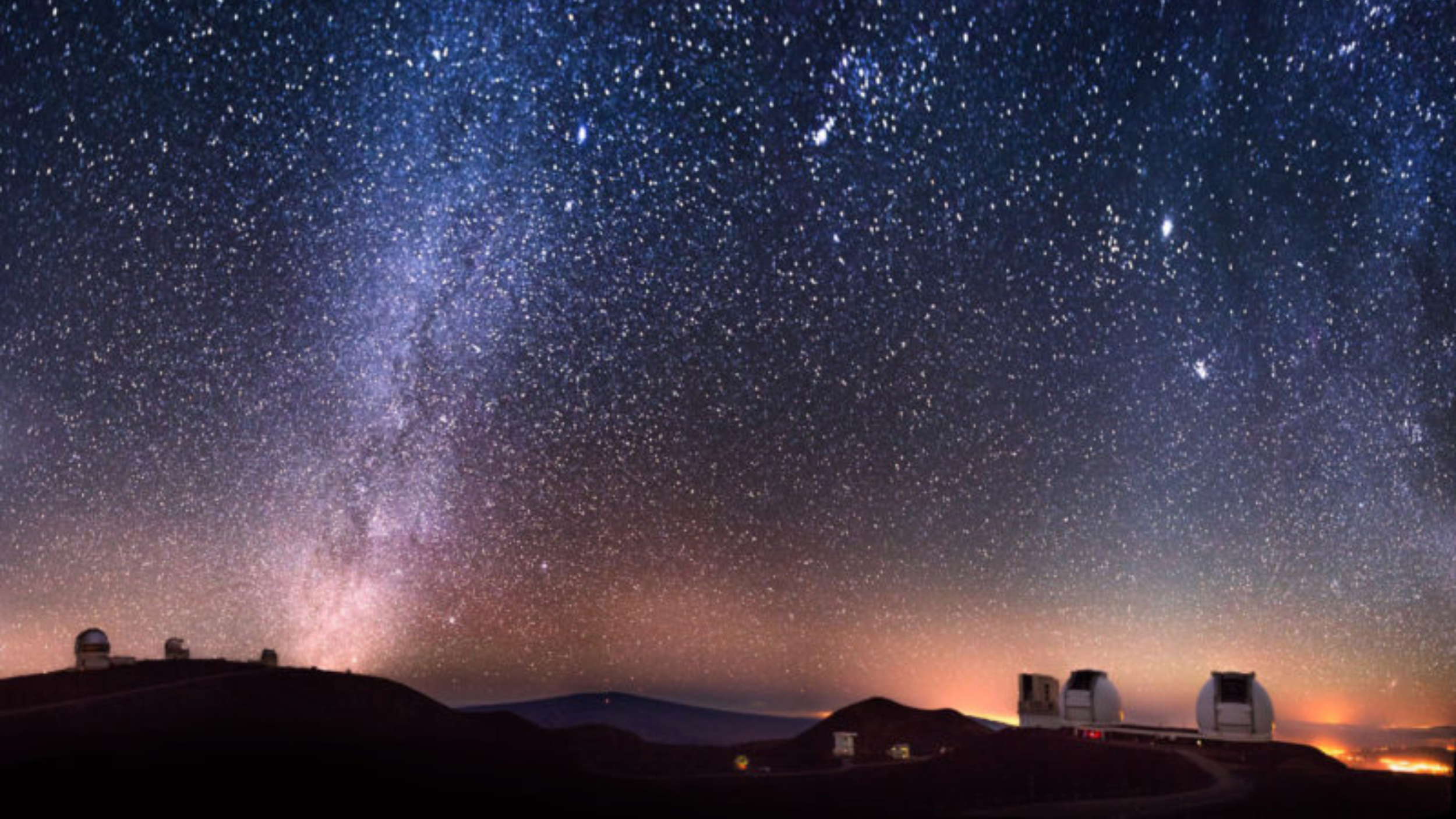
Mauna Kea Observatory
Astrology can easily become charts, symbols, interpretations and calculations.
Astronomy can easily become measurements, distances and classifications.
But beneath both lies something much older:
A human being standing beneath the heavens, wondering what all of this means.
Perhaps that is the place where these two estranged traditions can still meet.
Science Does Not Diminish the Sacred
For a long time, we’ve been encouraged to imagine science and spirituality as opposing ways of understanding reality.
One measures.
The other experiences.
One asks how.
The other often asks why.
But I’ve never found it necessary to choose between them.
Understanding axial precession doesn’t make the cosmos less mysterious to me.
It makes it more extraordinary.
Knowing that Earth is rotating, orbiting, tilting and precessing while our entire solar system moves through the galaxy does not diminish my sense of the Divine.
It deepens it.
Scientific knowledge can describe the movements of our universe with astonishing precision.
Spirituality can ask what it means to find ourselves conscious within that universe at all.
Those questions do not have to cancel one another.
They can humble one another.
Astrology as Relationship
This is ultimately what drew me more deeply into Vedic Astrology.
Not simply the question of whether one zodiac calculation was superior to another.
It was the invitation to experience myself differently.
Not as an isolated human being deposited into an indifferent universe, but as a participant within something incomprehensibly larger than myself.
The Sanskrit word traditionally used for Vedic Astrology is Jyotisha, often associated with light or illumination.
I find that beautiful.
Because perhaps the greatest value of astrology isn’t that it tells us what will happen next.
Perhaps its greatest value is that it reminds us to look beyond the boundaries of the little self and contemplate the vast intelligence within which our lives are unfolding.
The planets do not have to become objects of superstition.
The stars do not have to become fortune-telling devices.
They can become invitations to relationship.
To wonder.
To humility.
To curiosity.
And perhaps, ultimately, to the Creator.
Look Up
Our ancestors looked upward because the heavens were inseparable from life.
They navigated by them.
Planted by them.
Measured time by them.
Created myths around them.
Prayed beneath them.
And tried to understand themselves through them.
Today we possess infinitely more information about the universe than they did—and yet many of us have almost no experiential relationship with the night sky at all.
Perhaps the reconciliation I’m interested in is therefore larger than the reconciliation between tropical and sidereal astrology.
Larger even than the reconciliation between astrology and astronomy.
It is the reconciliation between ourselves and the cosmos from which we came.
Science can help us understand what is above us.
Astrology can offer one symbolic language through which we contemplate our participation within it.
And spirituality can return us to the deepest question beneath them both:
What is my relationship to the intelligence that created all of this—and that somehow created me within it?
I don’t believe we have to abandon reason to recover reverence.
Nor do we have to abandon reverence in order to embrace reason.
Perhaps we simply need to look up again.
