
Cosmic Blueprint & Sacred Maps
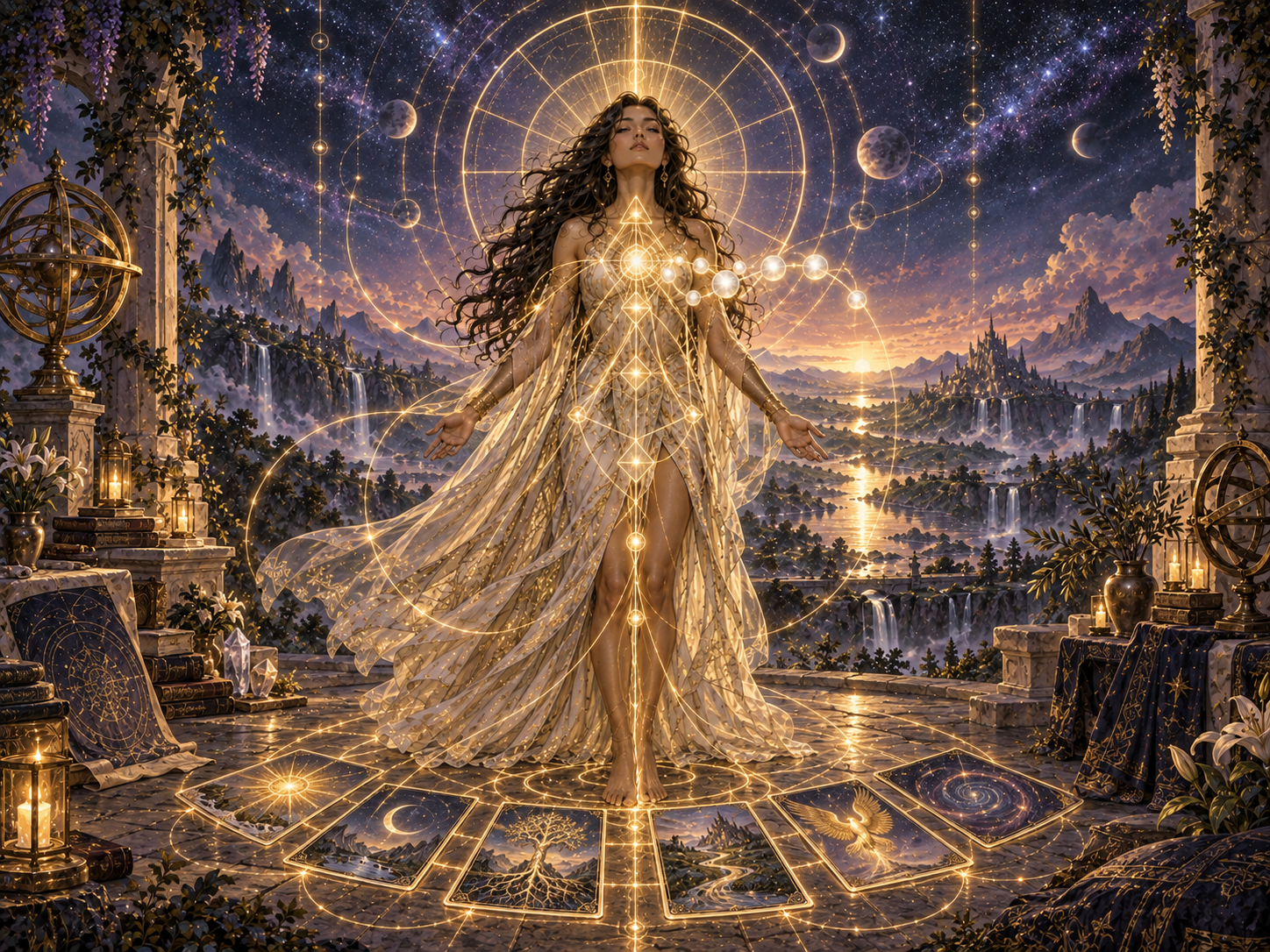
Many lenses, one living being
Imagine photographing a person from four different angles. In one image, you see the expression on their face. In another, the way they stand. A third catches the light on something you had not noticed before. Each photograph reveals something real, but no single frame can contain the whole person.
This is how I approach the sacred maps I use in my work. Vedic Astrology, Human Design, Gene Keys, and Tarot each offer a different camera angle on a life. Each has its own language, its own questions, and its own way of noticing patterns. Together, they can help us contemplate the particular energetic imprint we bring into the world. But none of them can tell us everything we are.
Vedic Astrology looks to the sky at the time of birth. Through its symbolic language, I explore the qualities and rhythms that may shape a person’s experience: where energy seems to gather, what themes return, and how different seasons of life invite growth. It offers a wide view, as though we have stepped back far enough to see the larger landscape.
Human Design offers another angle. Its chart draws attention to patterns of energy, interaction, and decision-making. I use it to ask where a person may move with greater ease, where they may be taking in pressures from the world around them, and what it feels like to make choices that are more honestly their own.
Gene Keys asks us to look more closely at how a familiar pattern might transform. Its language of Shadow, Gift, and Siddhi invites contemplation: What happens when we bring awareness to a quality we have feared or judged? What possibility lives within it? This is a lens I return to slowly, allowing insight to deepen through lived experience rather than trying to master a set of labels.
Tarot gives us a view of the present moment. A card can bring an image to a question we have been circling without words. It may illuminate a choice, a feeling, or a story we have been telling ourselves. Unlike a birth-based chart, it does not require your birth details; it offers a symbolic conversation with what is alive now.
These lenses may sometimes seem to agree. At other times, one will show a facet another leaves outside its frame. That does not make the person a contradiction. We are complex, and every map has a field of view.
I never want a reading to leave you feeling confined by a description of yourself. “This is your design” or “this is your chart” can sound like a verdict if we forget that we are speaking about symbols. A map can orient us, but you are the one living the terrain. Your relationships, circumstances, choices, and capacity to change belong in the conversation.
This is why I begin with the person in front of me. Which parts of a reading help you recognize something you have lived? Which parts invite curiosity? Which do not fit, or need more time? Your experience matters. You do not have to force yourself into a system for that system to be useful.
Our North Star is always a return to wholeness, not the discovery of a perfect label. These maps can give language to gifts we have overlooked and compassion for patterns we have struggled to understand. They may help us notice where we have been living according to someone else’s expectations, and where a truer expression is ready to emerge.
The deepest value of a map is what becomes possible after we set it down. Can we listen more closely to our bodies? Meet an old fear with greater presence? Make one freer choice? Offer our particular gifts with less apology? Insight begins to live when we carry it into ordinary life.
An invitation to explore:
If you already know something about your chart or profile, choose one quality you recognize in yourself. Ask: How does this show up in my lived experience? When does it feel open and life-giving? When does it feel constrained? What might help me meet it more consciously?
If you are new to these systems, you can begin with an even simpler question: What is one part of myself I am ready to understand with more kindness?
Every lens offers an angle. But the living whole remains yours to discover, embody, and express.
